Showing posts with label places. Show all posts

Tuesday, 11 December 2012

Some Reflections During a Stroll


I’ve been wishing to write something about this for quite some time. The context is simple: an interval of time between two professional appointments leaves me with some three hours in Porto. I don’t live here, so going home isn’t an option. I come by car, which has the advantage of providing me with a portable sofa with wide windows in front of it. Given that, all I have to do is choosing the view: I chose the one which is in front of me right now: the river Douro as it finally reaches the sea. Foz is the name of this part of town: the word denotes, in Portuguese, the mouth of a river. I know this river very well: I grew up beside one of its tributaries, and the simple name of it, Douro, meant to me the golden promise of distant horizons. I had learned at school that somewhere beyond the last hill I could see from my quiet country town the river Tua still ran southwest; and that, at some point, it surrendered its clear waters to the deeper flows of the Douro. I already had, back then, the idea that one day I would somehow follow the river, that someday I would accept its invitation and go. In fact, rivers stir the imagination: they come from somewhere and they go somewhere, and when one lives in front of one, as I did as a child, questions eventually arise as one cannot simply ignore that a part of the world, small as it may be,  flows before one’s eyes. Rivers are, above all, a constantly renewed invitation: to dream, to ask, to go, to live.
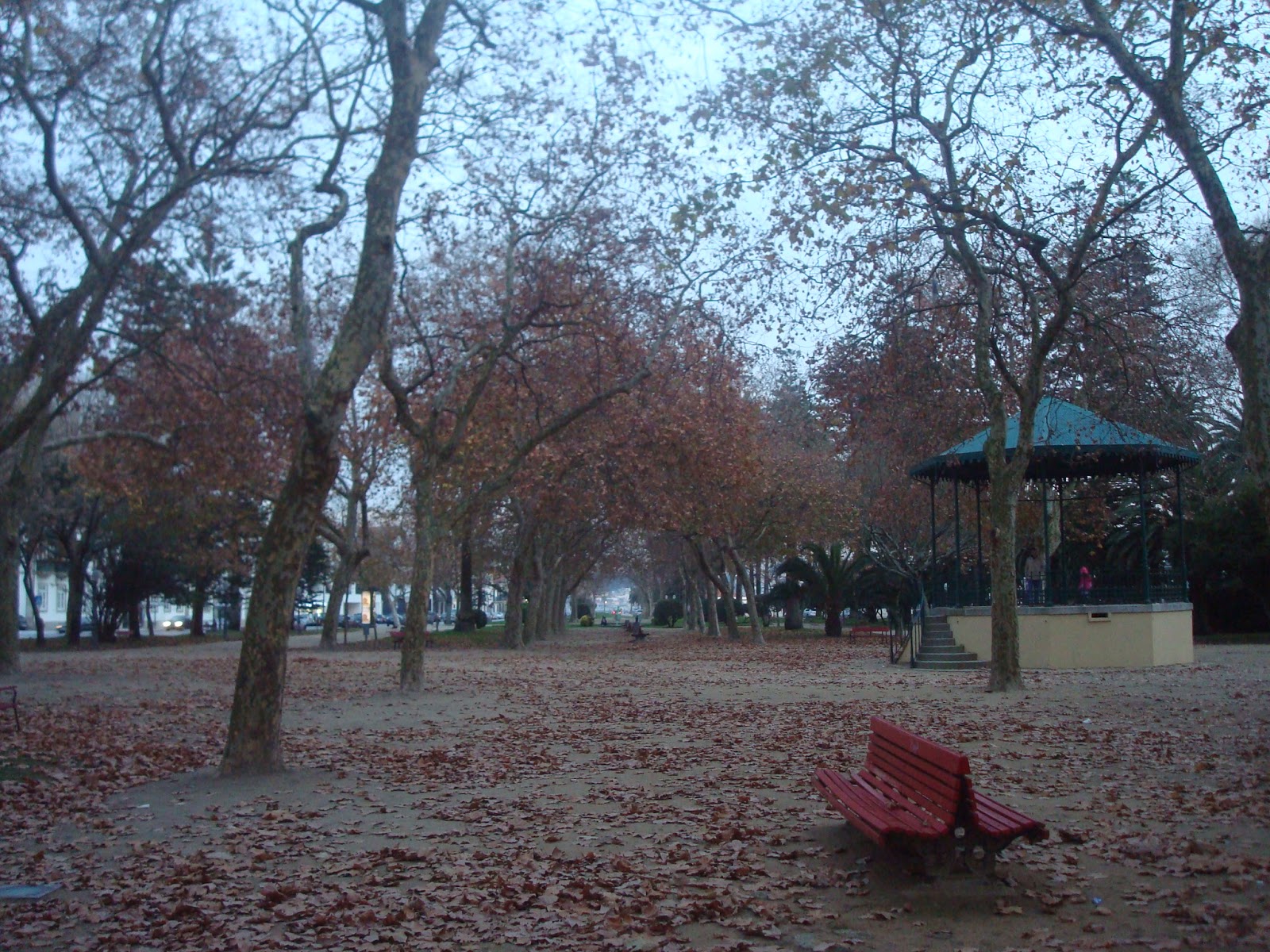
And now here I am. The afternoon is lovely, only slightly under the warmth of spring. As the sun hurries to kiss the surface of the Atlantic a cold reminder of winter quickens me. This is beautiful here. There’s a small park nearby, its romantic quaintness giving a delicate touch to the river’s final farewell, and there’s a pier, with people going back and forth, and fishing rods probing the river banks. There’s the city in the distance, and the day is approaching its end. I’m starting to feel some verbal laziness: I’ll take some pictures instead. 


Wednesday, 28 November 2012

A Post-industrial Vignette and a Driving Song


The density of the landscape slowly melts into the falling night. The hesitant rain, quietly coming and going, dots the windshield with ephemeral drops. I drive through the falling night: I drive back home, my eyes fixed on the red lights of the car in front of me. Postmodern life, I wonder, so replete with suburban roads and constant traffic flows, so glassy and dimly lit, so unpredictable: rhythms of work which are as hesitant as the autumn rain, now coming, now going, as capricious as the changing season. Winter is coming, by the way...
The car in front of me turns left and I unthinkingly probe the night with the high-beam lights. There’s not much to see beyond the flickering radius of the lampposts. Deserted sidewalks, precariously crammed between apparently empty houses and the road; scattered stores, here and there glimmering in the dark; and, overlooking the ensemble, heavy, silent and often crumbling buildings of old textile factories loom beyond the reach of the lights. The factories are everywhere: this is the heart of industrial Minho. Places like Vila das Aves, Moreira de Cónegos, Vizela, Pevidém, places with interesting names that may sometimes sound familiar on account of local football teams. Places of low wages, widespread illiteracy and rampant unemployment.
I stop somewhere among these places to pump fuel. Rising prices, a few cars and a lorry. As I finish pumping a car queues up behind mine. It takes rather long to pay. The lorry driver is telling a guy how easy it is to get a job when one has a driving license for heavy weight vehicles. In the meanwhile the cashier stares at the cash register, apparently unable to deal with some technical problem. The lorry driver completes his idea: “some money is needed to get all the proper licences, of course; prepare to spend some 3000 euros in the process”. The guy, not older than thirty, laughs off the idea: “3000 euros?” he gasps, mentally processing such a huge amount, such an unthinkable fortune; “I would get married if I had 3000 euros; why would I need a job in the first place if I had such money?”. 3000 euros, a driving licence, a job: those things are apparently way beyond the reach of the guy, their sheer inaccessibility making them not even worth the effort of trying. The lorry driver allows himself a little smile, takes his change and leaves.
As this edifying conversation takes place I keep looking at the car behind mine. It didn’t move, even though all pumps had long become available. Some ten minutes have gone by and there it is: why doesn’t its owner simply choose another pump? As I pay I notice that the fuel station staff is growing impatient with the guy. I learn that he must have been there for quite a while: he’s waiting for a coffee; I mean, he’s trying to persuade the staff into giving him a coffee: “I would pay for it if I had 3000 euros”, he amusedly says.
I take my change, slightly disturbed by the passivity of the customer who keeps on waiting behind my car. I’m about to make some gesture, some shoulder shrugging, something that could express some empathy, some regret for the time it took me to pay when I actually see the driver: a middle-aged woman, her eyes blankly looking at some fixed point in the distance; there’s no sign in her whatsoever indicating that she had moved at all during the nearly fifteen minutes it took me to pay; I give up my shoulder shrugging: she simply didn’t see me. In her eyes nothing but absolute nothingness.
I have seen this look on other people’s faces: the look of purposelessness. Time stretches no more than a day for these people, the future lying somewhere in the distance, vanishing beyond the radius of the lampposts, darkened by the crumbling building of some old textile factory. They are utterly demoralized by having nothing to do, nothing to expect, nothing to hope for.
I drive through the night. I turn on the radio: news of austerity darken the darkness even more. I change to another station and some music fills the car. Driving music, how appropriate: this one, to be more precise.


Monday, 5 March 2012

Eucalypti


                   There was a time before them, of course. One of the earliest literary references to them can be traced back to the late nineteenth century. In Eça de Queirós’ The City and the Mountains the main character Jacinto, a Portuguese aristocrat living in Paris who had recently discovered the charms of rural Portugal, complains about how slow the rhythms of nature are. Realizing that during his whole princely life amidst the comforts of civilization he had never planted a tree, he asks which one is the fastest-growing, only to be appalled by the answer. “An oak tree!” - he whines - “Thirty years before it turns into something beautiful… I falter. That’s good for God, who can wait. (…) Thirty years! In thirty years, trees!... Only if it were to cover my grave!” The alternative, the fastest-growing tree, is the eucalyptus, “the horrible and ridiculous eucalyptus. In six years you get the whole Tormes covered with them”. Jacinto doesn’t seem to have accepted the suggestion as Tormes, the bend of the Douro river where the action takes place, has so far remained fairly eucalyptus-free. Unfortunately, most of the country has not been that lucky.
                Eucalypti are ugly indeed. Their bluish green colour is unattractive. Their shape is uninteresting. The shade they throw is mostly uninviting and often dangerous, as they like to drop branches on people’s heads. Only the bigger ones which can sometimes be seen besides some inland faraway road deserve some respect, and even so only because of their sheer size. Botanically speaking, they’re little more than water-sucking rascals, their smell being the only positive thing about them. That and obviously the money the paper industry makes from them (which, of course, doesn’t allow them the time to grow to a respectable size). Their worth as sources of pulp is the obvious reason behind their being almost everywhere in Portugal. That wouldn’t be strange in itself, being just another example of landscape being destroyed for profit. However, there has been an odd insistence on calling them forest, the weirdest thing being that people have actually come to see idyllic woodlands in the shabby agglomerations of eucalypti. This phenomenon illustrates an inconvenient truth about today’s social life: in fact, the media can convince an entire society of virtually anything nowadays.
              This curious collective illusion reaches its peak during the summer, being one of the essential markers of our cherished silly season. As everybody knows, eucalypti burn. It’s in their nature. Besides drying up the land and covering it in litter, they release highly combustible oils. Fire actually benefits them: they easily survive it, getting rid of the competition in the process. Wildfires in Portugal are then something quite epic, as areas bigger than Luxembourg vanish in the blink of an eye. The media gather around the fires, and the whole thing gains the appearance of a Hollywood super production (only, in version bad), with the firemen running and yelling around, elderly people praying, locals carrying pointless water buckets and reporters making live inventories of fire-fighting equipment, starting with the firemen and ending in the aerial means (they never say planes or helicopters). In the middle of all this eucalypti are the big elephant in the room: they are never mentioned, disguised behind the generic label of forest. People in positions of responsibility diffusely talk about prevention (and how much it costs), campaigns on TV urge people to be careful when they make picnics and for some weeks the whole country repeats that something has definitely to be done to solve the problem. But then, of course, nothing happens, and a revealing pattern goes largely unnoticed: the fact that only eucalypti and large spots of pine trees (equally artificial) burn. Everywhere where some faraway traces of our original and autochthonous forest are still extant, wildfires are much rarer or outright absent. Nevertheless, people naively carry on believing that every summer the country turns into a postcard of hell simply because of driving smokers, another wonder of contemporary media constructivism. Most people in Portugal actually believe that the country has always been like this. They have no idea of what an actual forest looks like, they are utterly ignorant of how spoilt the country really is and, even if they weren’t, they just wouldn’t care. In the contemporary Portuguese psyche trees, along with plants, vegetables, agriculture and nurturing the land in general are reminders of a poorer time. A rapidly urbanizing people has no time for such things.


                In fact, we’ve been following Jacinto’s footsteps... in both directions. We’ve been commuting between civilization and nature, living in none. Believing ourselves rich and too sophisticated for rural life, we have deserted for the large towns. That’s where the shopping centers are; that’s where the wide suburban motorways lead; that’s where all the excitement is; that’s where all the jobs are, we thought. Alas, we were just eagerly consuming a second-hand civilization, sent by parcels from Europe, as somewhere someone says in one of Eça’s books… The fires, the abandoned land, the dying villages, the dams forever sinking areas of outstanding natural beauty, the increasingly frequent droughts had become mere echoes of a past world, while simultaneously the countryside was gradually becoming the symbol of a lost identity. As the optimistic certainties of modernity keep fading, many Portuguese are now looking back to it in nostalgia. David Lowenthal says that “if the past is a foreign country, nostalgia has made it the country with the healthiest tourist trade of all”. We have thus every reason to believe that the Portuguese are returning to the countryside not as the actual owners of the land, but as mere tourists: as superficially and naïvely as tourists and equally ignorant of the ways of the land. On the contrary an actual appropriation of the land would require the knowledge to interpret its symbols: the Portuguese have willfully lost the common sense acquaintance with the land they once had, and have never bothered acquiring the scientific, contemporary and reflexive understanding of it. It is not to uncover the meaning of the land that the Portuguese are returning to it: it is merely to quiet the torments of post-modern living with a weekend escapade. In the meanwhile, and since man can’t live without some level of interpretation of his environment, the show must and will go on. Eucalypti will keep on burning while we flee to the coast, thus providing the distinctive smoky atmosphere we so much appreciate in our summers and the ultimate symbol of the Portuguese man’s disconnectedness with his native land.


                So, there’s surely been a time before them, but now they seem to be here to stay. A solution might be to fell them all outright, plant oaks in their place and wait for some three decades. That seems impossible, however. We can only watch them burn, only to be replanted, to burn again, to be replanted…     

Tuesday, 28 February 2012

The Story of a Square


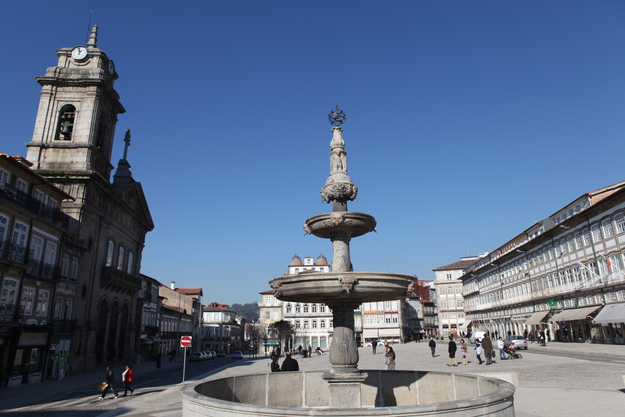
On the way here I saw an antique photograph of the Toural Square, occupying the centre of an apparently abandoned shop display. The place where I am now, the destination of my half-leisurely stroll, is the Milenário Café. I’m now sitting at a table by one of its large windows overlooking the Toural, the main square of the town of Guimarães, in northern Portugal. Guimarães is known as the cradle of the country and is also, by the way, the current European Capital of Culture. Much has been changed in the previous look of the town in order to prepare it for that event. The Toural, as one of the most iconic sights of the town, was naturally at the centre of a whirlwind of construction works for quite a long time. It opened a couple of months ago amid the usual mixed feelings of the locals, with positive impressions only slightly beating the negative ones. Personally I liked it, but then I’m not a local, so my opinion doesn’t really matter much for the point I’m trying to make here.
People from Guimarães (the vimaranenses) like to think of their town and themselves as a peculiar case of identity, almost as if they were the representatives of a different people inhabiting a country within the country: quintessentially Portuguese, but not mainstream Portuguese. They combine in an attitude that resembles a sort of local nationalism an extreme pride in their town and an obstinate sense of uniqueness. While the former is amply justified by the sheer beauty of the town, the latter is largely an exaggeration. In fact, most cultural traits of Guimarães have, in one form or another, equivalents in most comparable Portuguese towns, at least the northerly ones.
The history of the Toural is a good example of that. Originally, and judging from its name, it must have been the place of cattle fairs. However, old photographs already show the typical Portuguese square of the nineteenth century: neat, with a love of detail and closed. The entrance to the inner part of it was paid, thus making the place an exclusive of the better-off classes. The majority of the people would just stay outside staring at the Sunday stroll of the bourgeoisie. Public space was then a perfect symbol of society, its carefully marked social divisions echoing the God-given order of things.


Then the iron fence disappeared, and with it the social prestige of the centre of the square. The benches were now available to everyone, as well as the shade thrown by the trees, but only retired elderly people sat there. The square was consciously becoming a place of memory, a symbol of what the town no longer was. Those were the days of democratisation, of economic growth, of high buildings, big roads and shopping centres. A modern monument then occupied the place where previously there had been a fifteenth-century water fountain, its electrically powered jets of water mocking its predecessor. The advent of the era of memory, culminating in the classification of the historic centre of Guimarães by the UNESCO, can hardly disguise that everywhere memory was being wilfully shunned. Real memory, and not the cheap imitation sold to tourists, was now abandoned on the fringes of society, the exclusive property of a new kind of socially excluded people, the elderly.


Now things seem to be changing again, and the Toural along with them. The fifteenth-century water fountain has returned, the electrically powered water jets have vanished along with most trees. The benches have been relegated to a discrete an uninviting corner of the square, as there wasn’t enough courage to get rid of them altogether. The black and white patterns of the traditional Portuguese cobblestone walkways were replaced by some inconsequent lines casually drawn on the floor. The square has lost many of the features that made it a cosy place where to stay, in fact, that made it a place at all. Now people pass through it, more or less hurriedly depending on whether they are locals or tourists. The new Toural gives the town a cosmopolitan outlook, the uneven façades of the buildings adding the necessary local taste to an urban landscape that is essentially and intentionally tasteless. A church, some nineteenth-century buildings, a granite building that vaguely resembles a rural manor-house, a remarkably homogenous series of white buildings that bring to memory the downtown of Lisbon, a fascist style building housing Portugal’s public bank and a trace of a medieval wall claiming that Portugal was born here: an historical and architectural composite framing an experience of vague out-of-placeness. I can’t think of a better metaphor for the times we’re living... 


Saturday, 24 December 2011

Remembrance of Things Past


The frail winter sun that caresses this windswept park in a quiet northern country town is of little solace, its pale warmth adding no more than a superficial joy to my being here. The sun will soon fade, leaving in its place the inconstant trace of undreamt of stars; very soon the wind shall be all that remains for the senses to delight in, the last tangible sign of life left in this quiet, time-forgotten and world-forsaken country town. I always loved the wind here, its sudden coldness on long summer sunsets being a symbol of life’s inexorabilities, the seductive uncertainty of its source breeding in me an imprecise urge to leave, its dreamy wintry iciness printing in my skin the longing for faraway places.
I left this place, but the wind didn’t. It keeps on sweeping the park, feeding extant tree leaves with a little life, keeping the town warm in forgetful chill. I’m like the wintry sun, only occasionally touching the streets of this quiet country town, a passer-by in the landscape of my early youth. I’m not very original in that: everywhere I see dimly familiar faces of people like me, who have left and returned, each one treading the clew of his own memories.
Getting entangled in the treacherous web of the past is an often overlooked part of Christmas. In fact, it is certainly also that: a yearly return to the past, a revisiting of dormant memories, a sometimes unwilling disturbing of the waters. And yet, there’s a river in my hometown, my whole childhood was indeed a flowing river of happy forgetfulness, as childhood always is, still untainted by the mark of remembrance…
Sitting here, in this café overlooking the sunlit townscape, I vaguely remember the ancient Lethe while I quietly contemplate the impossibility of complete oblivion. I’m not very original in that, either: with a deft extension of the meaning of the words I’m writing, I’m not even individual anymore. Each generation destroys the past, only to be destroyed amidst it in the end. Like everybody else before me, I had to destroy the past, only to find myself entangled in its reflection. There’s no Lethe except in the underworld: there’s no forgetfulness but in death. Each return is a rebirth, as every winter turns into spring. The wind, in the meanwhile, shall keep sweeping the landscape of our lives, as inescapable as the swift passing of time.

Merry Christmas.