Tuesday, 27 January 2015

Le Pen, France and the Limits of Multiculturalism

In the wake of the Paris Marine Le Pen wrote an article on the New York Times (To Call this Threat by this Name). There should be no surprise, no special mention of the freedom of speech, no second-guessing the intentions of the editors of the newspaper (or the amount of courage it might have taken to publish the piece): just mere normality, day-to-day production and destruction of ideas in the public square of print. I read the article, of course. I must say I never fail to be pleased by the far right’s willingness to slash political correctness. Using the real names of things I henceforward quote:

the massive waves of immigration, both legal and clandestine, our country has experienced for decades have prevented the implementation of a proper assimilation policy (…) [w]ithout a policy restricting immigration, it becomes difficult, if not impossible, to fight against communalism and the rise of ways of life at odds with laïcité, France’s distinctive form of secularism, and other laws and values of the French Republic.

The concept of community and communalism is central here. I absolutely agree with the stated need of fighting communalism, i.e. the forming of small groups of people who, for whatever reason, live outside and beyond what is commonly accepted as the social norm. To many, this might sound like a praise of oppression and a call to conformity; to those, I’d simply answer that communities are the way humans have found of maximizing their individual level of freedom: on the one hand, it’s impossible to be free on one’s own; on the other hand cooperation has infinitely enhanced our chances of survival, as we’ve known at least since we succeeded to kill the first mammoth. Larger, more comprehensive communities which allow more room for social experimentation widen individual horizons and chances. Personally I feel that my community is the whole of mankind, perhaps even more than that. That’s actually where my disagreement with Le Pen starts: her notion of community is far too narrow for me. In fact, and despite my love of French cheese, the baguette, Cassoulet and Bordeaux wine, I’d probably find myself excluded from her vision of a neat alpine douce France. The romantic nationalist notion of nation is in itself a form of narrow communalism and civic republican France is also a sort of religious praxis, with its rituals, its public gatherings, its solemnity and fanfarre. Nationalism is also a sort of revealed absolute truth and thus as prone as religion to fuel violence and war. All over Europe history readers shiver when she equates the name of France to the very idea of freedom: it reminds them of the revolutionary wars of the XIXth century.

My rejection of narrow communalism doesn't amount to an overall rejection of the notion of community. As culture is the binding fabric of community, there has to be some comprehensive yet unified cultural environment even in contemporary European societies. The simple truth is that not all conceivable lifestyles are mutually compatible and consequently there are indeed limits to tolerance. Suttee was incompatible with British law in colonial India, a situation which was solved by superior Western firepower: but really, does anyone miss that lovely cultural peculiarity? Aren't there, after all, lifestyles which are obviously more worthy than others and thus deserve being generalized, as opposed to some which should be eradicated? The problem is, however, that this is a battle nobody in post-war Europe really felt like fighting: the war for hearts and minds. An article by Stratfor exposes the lie at the heart of post-war Europe, but there’s a word in German which summarizes the whole thing, Gastarbeiter, or guest-worker: basically the ingrained notion that all those Turks, Italians and even Portuguese who were economically useful during the Wirtschaftswunder years were just a passing feature of the German landscape, bound to be blown away by the wind of economic change. As they weren't going to stay anyway the need to make them German, French or European was perceived as secondary.

This dilemma is compounded by Europe's hidden secret: The Europeans do not see Muslims from North Africa or Turkey as Europeans, nor do they intend to allow them to be Europeans. The European solution to their isolation is the concept of multiculturalism — on the surface a most liberal notion, and in practice, a movement for both cultural fragmentation and ghettoization. (…)[T]he dirty secret of multiculturalism was that its consequence was to perpetuate Muslim isolation. And it was not the intention of Muslims to become Europeans, even if they could. They came to make money, not become French. The shallowness of the European post-war values system thereby becomes the horror show that occurred in Paris last week. A War Between Two Worlds | Stratfor 

Live and let live has thus led to indifference. Unable to believe in ourselves we have waived the right and duty to convince others. Traumatized perhaps by centuries of colonial empire we have groomed radical otherness within our own borders. With some hindsight it’s perfectly clear that it was only a matter of time before something like this happened. The battle for hearts and minds may be a lot more difficult to win now, but still there's no alternative.

Tuesday, 27 May 2014

Political Centre: Early Signs of Collapse?


               On the surface things don’t seem to have significantly changed in Portugal’s political landscape in the wake of yesterday’s European elections. The Socialist Party beat the ruling centre-right coalition with a lower-than-expected margin. Marinho e Pinto’s surrogate party MPT benefited from the electoral one-man-show of the season: the controversial independent surged this small party’s vote turnover to the point of getting elected in what turned out to be a rather expected surprise. The Communist Party, usual receivers of the disaffected vote in a country with no far-right alternatives such as France’s Front Nationale our UK’s UKip, scored quite well too. But the analysis of the results has largely missed the point, I think. As the marginally victorious mainstream left tries to pose as a credible government alternative and the ruling centre-right party sighs with relief, a deeper, more worrying truth is lurking under the sound bites: the political centre is growing weaker. 
               I mean, let’s look at the figures: in absolute terms the winning party managed to get just over one million votes; the ruling coalition, two parties which on the last legislative elections accounted for almost 3 million votes together, plummeted to around 900.000 yesterday. High levels of abstention notwithstanding, this is a fact both parties are well aware of: they’re weaker and weaker, weak to the point of both considering an until recently inconceivable possibility, i.e. forming a central coalition (which, I think, as a remedy would be worse than the disease). In the midst of this it’s the ruling coalition’s reaction that sounds the most ironic. By minimizing the socialist victory, they’re just making their own collapse more visible: they were defeated by the lowest-scoring Socialist Party victory ever. Such an outcome should be cause for alarm: instead, both parties will cause each other further attrition, until they eventually fall prey to some emerging charismatic character. MPT’s Marinho e Pinto has set the tone for the near future: a loud political commentator with inquisitorial tendencies (an “everyone is corrupt except me” kind of routine) has outmanoeuvred candidates like Rui Tavares, who yesterday failed re-election at the head of a newly-formed party (we have sixteen already). With a much more recommendable track record, his more low-key attitude and articulate political statements seemed to have rendered him essentially unintelligible for the larger public: too long, too smart, too traditional, too serious even. By contrast, and despite his general Torquemada-style vociferations, Marinho e Pinto has never said, in clear terms, where he stands. I was unable to discern his political whereabouts, and that was precisely what his go-for-all attitude aimed at preventing voters from doing. Thus vagueness becomes an advantage. 
                But even more worrying was that for all Marinho e Pinto’s understandable vagueness (he’s just a secondary character in this play, after all, bound to fade into the distance as soon as he takes office in Brussels), the two major parties managed to be even vaguer, arcane even. The political mainstream seems to be failing to articulate even the simplest of promises, let alone a coherent project for the country. Both on the right and the left, the habit of speaking through the medium of macroeconomic data has estranged them from their public. When politics seems to be no more than a matter of lines going up and down on a graph the need for voters to state their opinions appears to fade. More than disaffection, discontent or lack of interest, yesterday’s election results hint at something even worse: on the one hand, there’s the growing inability of those who rule to explain to those whom they rule what they’re doing; on the other hand, there’s the common man struggling to even begin to fathom what it is all about. Then, politicians try to make do with what’s left. Enacted the way it has been, politics is little more than a fast-degrading pantomime. Politically savvy people may concede that there’s inevitably a degree of farce in public life, even as they disapprove of the hollow nature of much of the drama; as for the majority of people, sunk as they are in inaction, the buffoon eventually has the upper hand when it comes to capturing their attention. By speaking the language of the public, candidates such as Marinho e Pinto manage to temporarily bridge the gap between the common man and the elites: we are all aware of the dangers involved in this process, but it’s not the purported demagogue that worries me here. Rather, it’s the emptiness, the growing mood of uselessness: the feeling that voting is turning into the habit of a minority of people who still strive to make sense of it all; the impression that political statements just dissolve into thin air as the arid vocabulary of management progressively engulfs every aspect of public life; the joke, progressively and disturbingly taken more seriously, that we could as well get a management consultancy to run the country. 
              The political centre is getting weaker in Europe (and Portugal is no exception) not because the extremes have become intrinsically attractive, but simply because politics isn’t making sense anymore in the mind of the common man. His vote, when he bothers using it, just adds to the joke politics already is. Doubts? Again to the raw figures: null and blank votes amount to nearly a quarter of a million; if counted, they would have elected two representatives. 

Tuesday, 11 December 2012

Some Reflections During a Stroll


I’ve been wishing to write something about this for quite some time. The context is simple: an interval of time between two professional appointments leaves me with some three hours in Porto. I don’t live here, so going home isn’t an option. I come by car, which has the advantage of providing me with a portable sofa with wide windows in front of it. Given that, all I have to do is choosing the view: I chose the one which is in front of me right now: the river Douro as it finally reaches the sea. Foz is the name of this part of town: the word denotes, in Portuguese, the mouth of a river. I know this river very well: I grew up beside one of its tributaries, and the simple name of it, Douro, meant to me the golden promise of distant horizons. I had learned at school that somewhere beyond the last hill I could see from my quiet country town the river Tua still ran southwest; and that, at some point, it surrendered its clear waters to the deeper flows of the Douro. I already had, back then, the idea that one day I would somehow follow the river, that someday I would accept its invitation and go. In fact, rivers stir the imagination: they come from somewhere and they go somewhere, and when one lives in front of one, as I did as a child, questions eventually arise as one cannot simply ignore that a part of the world, small as it may be,  flows before one’s eyes. Rivers are, above all, a constantly renewed invitation: to dream, to ask, to go, to live.
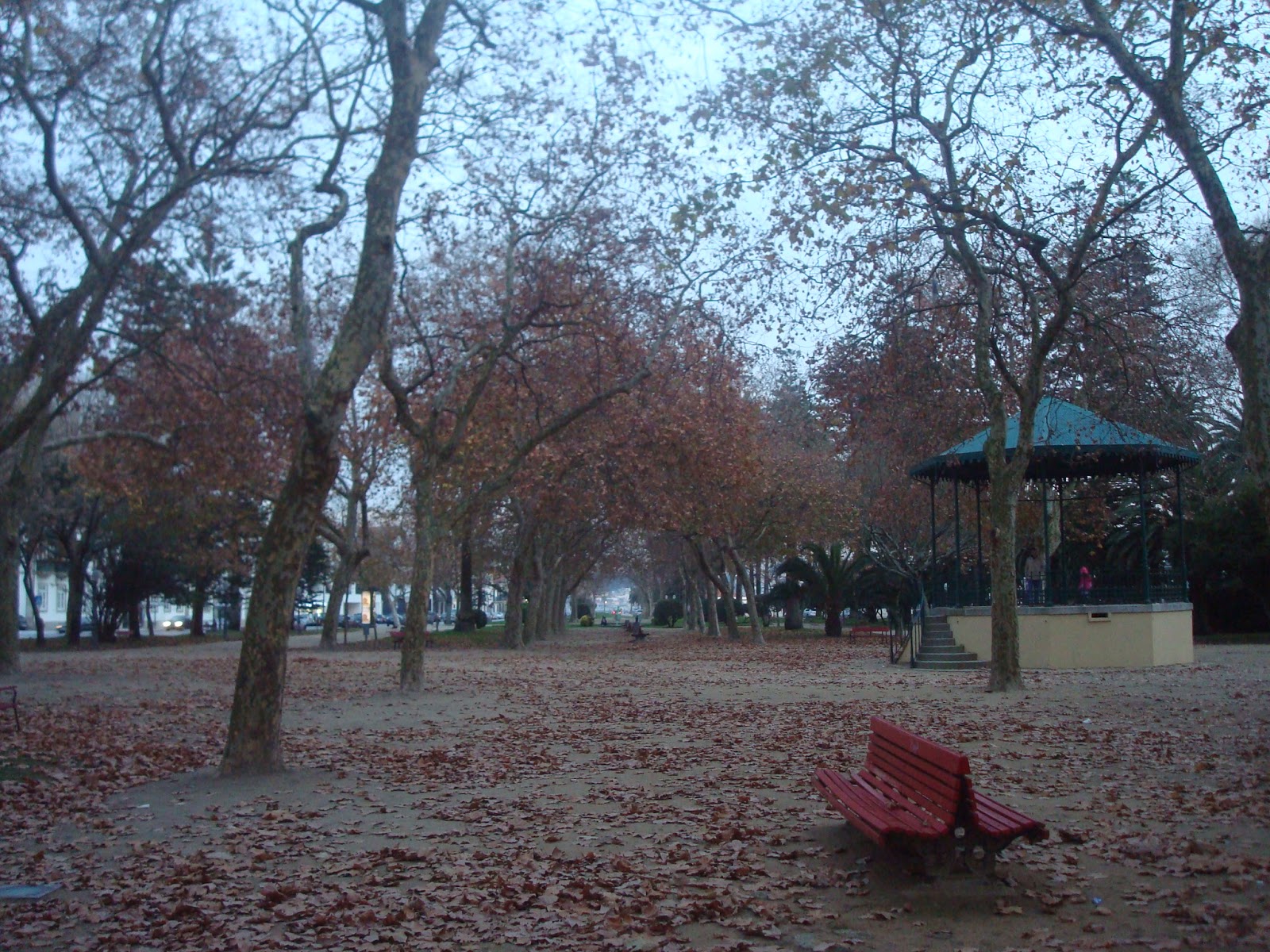
And now here I am. The afternoon is lovely, only slightly under the warmth of spring. As the sun hurries to kiss the surface of the Atlantic a cold reminder of winter quickens me. This is beautiful here. There’s a small park nearby, its romantic quaintness giving a delicate touch to the river’s final farewell, and there’s a pier, with people going back and forth, and fishing rods probing the river banks. There’s the city in the distance, and the day is approaching its end. I’m starting to feel some verbal laziness: I’ll take some pictures instead. 


Friday, 30 November 2012

My Country, Today


        One might as well ask if it really had to take a deep economic crisis to make the portuguese finally understand what the idea of society is meant to signify. One might as well wonder if only a neoliberal shock could show us crystal clear what politics is about. One might also think that only a deep social and economic crisis could awaken us from the civic slumber we had indulged ourselves with. In the meanwhile, one might as well have remembered, perhaps inspired by the examples of past generations, that it takes blood, tears, toil and sweat to actually build anything worthy of admiration. And, by the way, we could also had borne in mind a clear picture of our utter fragility, a constantly renewed consciousness that no man is an island and that there is no such thing as a self-made-man: not in Europe, not even in America and much less in Portugal. We could have learnt the lessons our very landscape taught us: the harsh climate of the north, its rocky stubbornness yielding only to the strength of many arms combined; the dry extensions of the south, their flat horizons turned into blood-stained gold by the sweat of many and the profit of few; and the sea, the never-ending sea, the eternally mysterious sea. We could have remained wise, but we haven't. We could have been faithful to ourselves, but we haven't. And now we’re lost: as we have always been.  

Wednesday, 28 November 2012

A Post-industrial Vignette and a Driving Song


The density of the landscape slowly melts into the falling night. The hesitant rain, quietly coming and going, dots the windshield with ephemeral drops. I drive through the falling night: I drive back home, my eyes fixed on the red lights of the car in front of me. Postmodern life, I wonder, so replete with suburban roads and constant traffic flows, so glassy and dimly lit, so unpredictable: rhythms of work which are as hesitant as the autumn rain, now coming, now going, as capricious as the changing season. Winter is coming, by the way...
The car in front of me turns left and I unthinkingly probe the night with the high-beam lights. There’s not much to see beyond the flickering radius of the lampposts. Deserted sidewalks, precariously crammed between apparently empty houses and the road; scattered stores, here and there glimmering in the dark; and, overlooking the ensemble, heavy, silent and often crumbling buildings of old textile factories loom beyond the reach of the lights. The factories are everywhere: this is the heart of industrial Minho. Places like Vila das Aves, Moreira de Cónegos, Vizela, Pevidém, places with interesting names that may sometimes sound familiar on account of local football teams. Places of low wages, widespread illiteracy and rampant unemployment.
I stop somewhere among these places to pump fuel. Rising prices, a few cars and a lorry. As I finish pumping a car queues up behind mine. It takes rather long to pay. The lorry driver is telling a guy how easy it is to get a job when one has a driving license for heavy weight vehicles. In the meanwhile the cashier stares at the cash register, apparently unable to deal with some technical problem. The lorry driver completes his idea: “some money is needed to get all the proper licences, of course; prepare to spend some 3000 euros in the process”. The guy, not older than thirty, laughs off the idea: “3000 euros?” he gasps, mentally processing such a huge amount, such an unthinkable fortune; “I would get married if I had 3000 euros; why would I need a job in the first place if I had such money?”. 3000 euros, a driving licence, a job: those things are apparently way beyond the reach of the guy, their sheer inaccessibility making them not even worth the effort of trying. The lorry driver allows himself a little smile, takes his change and leaves.
As this edifying conversation takes place I keep looking at the car behind mine. It didn’t move, even though all pumps had long become available. Some ten minutes have gone by and there it is: why doesn’t its owner simply choose another pump? As I pay I notice that the fuel station staff is growing impatient with the guy. I learn that he must have been there for quite a while: he’s waiting for a coffee; I mean, he’s trying to persuade the staff into giving him a coffee: “I would pay for it if I had 3000 euros”, he amusedly says.
I take my change, slightly disturbed by the passivity of the customer who keeps on waiting behind my car. I’m about to make some gesture, some shoulder shrugging, something that could express some empathy, some regret for the time it took me to pay when I actually see the driver: a middle-aged woman, her eyes blankly looking at some fixed point in the distance; there’s no sign in her whatsoever indicating that she had moved at all during the nearly fifteen minutes it took me to pay; I give up my shoulder shrugging: she simply didn’t see me. In her eyes nothing but absolute nothingness.
I have seen this look on other people’s faces: the look of purposelessness. Time stretches no more than a day for these people, the future lying somewhere in the distance, vanishing beyond the radius of the lampposts, darkened by the crumbling building of some old textile factory. They are utterly demoralized by having nothing to do, nothing to expect, nothing to hope for.
I drive through the night. I turn on the radio: news of austerity darken the darkness even more. I change to another station and some music fills the car. Driving music, how appropriate: this one, to be more precise.


Wednesday, 24 October 2012

Twenty-odd Years in one Watch


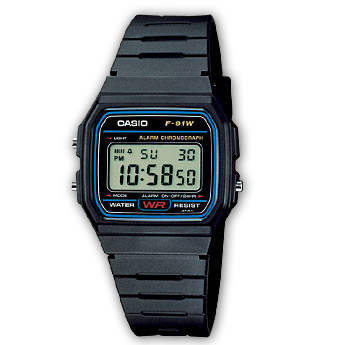
             As a kid I remember my schoolmates showing theirs, proudly activating the faint green light which we saw flickering through the dark hollow made with our hands. It was a symbol of a certain kind of modernity, a type of civilization which only then Portugal had fully entered: technological civilization for sure, but also the worldwide market of cheap eastern gadgetry. In personal terms, and for little kids who had just learnt how to count, a watch was also the first tangible sign of independence: if not sovereignty over time (by then we still naively thought we would conquer it one day) at least awareness of its passing. I thought however, at the time, that the facilitated reading of the time afforded by a digital watch was cheating somehow: from the very beginning I preferred the complicated turning around of hour, minute and second hands one can see on analogue watches. I never had a Casio F-91W as a kid, I never asked my parents for one. Until rather recently I consistently relied on freebie watches or Chinese ones which hopefully would last for some months. On my early twenties I was finally offered my first adulthood watch: a black analogue Pulsar, and then two more watches came along, a blue Swatch and a brown, rather more classic French one. The last time I remember thinking about the Casio F-91W was around September 2001 and the reasons couldn’t be worse: bin Laden wore one in one of the videos in which he appeared, with his finger pointing up, threatening the West. I remember commenting on that with some friends back in high school: couldn’t he at least afford a better watch? The watch became suspicious in America on account of that, years after its appearance marked the end of a certain kind of American international supremacy: the rise of the East with the ensuing global bombardment of cheap plastic. Lately I decided to buy one: I needed a cheap watch, with a clearly visible stopwatch to jog with. I was slightly disappointed to see that they aren’t manufactured in Japan anymore (were they ever?), the inevitable “made in China” glittering on its back. It is still interesting though, its retro-futuristic style marking a past perception of what the future would be. It turned out to be quite different, but then that’s a secret in time that watches don’t tell.

Saturday, 14 July 2012

The Meaning of Unemployment


            The two things may seem unrelated but as I was reading about Stuart Hall and Roland Barthes in a book about cultural studies the blog o desemprego tem rosto (unemployment has a face) immediately came to my mind. The website is a one-year long project described by the newspaper which publishes it as a photographic essay made with the aim of giving the Portuguese unemployed a voice of their own: a touch of human actuality to help break down the hegemony of cold statistics and faceless numbers. In terms of layout the concept is remarkably simple: over a dark background a black and white close-up photograph of a face and a mini-interview with questions such as how old are you, how long have you been unemployed, what was your last job, what are your educational achievements, what do you expect the future to be
         It is certainly interesting to note how people articulate their speech or, more specifically, their self-representation in the face of the particularly difficult context of their lives and in the broader scope of Portuguese society in general. Contrary to the apparent homogeneity of the mainstream narrative of unemployment, common people show a remarkable variety of stories about this alarming social concern. The fact is that the wearied talk about the economic crisis reverberates kaleidoscopically in popular expressions of actual unemployment, according to the specific circumstances of each person’s life. Ideology, as Barthes refers to it (the mainstream meaning of unemployment disseminated, with the help of the traditional media, by both the political and economic elites, with the maintenance of the status quo in mind), thus echoes increasingly dimly within the people who actually have to face the social and individual consequences of unemployment on a daily basis. 
           As ideology wanes so the legitimacy of the whole political system begins to falter: in the specific case of Portugal it would be fair to say that we’re living the final days of a social grand narrative which started with the Carnage Revolution. The question that nowadays dominates social debate is, however, one of alternatives: all over the West, and most likely beyond it, the what to do of the whole thing is far more a blank than the already contentious affair of the how did we end up in this mess. This blank, translated in the general moral void into which society has fallen, is a huge challenge to social agents of signification everywhere. The most interesting point about the aforementioned blog is how this challenge is being individually met by common people in the field. 
            A reading of its entries shows how the poorest among the poor cannot even articulate the proper words to define their situation. Their laconic answers and meagre use of language bears testimony to the real nature of their poverty: in fact, they’re in a state of utter symbolic deprivation. Referring to what Stuart Hall calls the struggle to signify it is fair to say that they lost the battle of signification before it had even begun. Others, usually younger and holding a university degree, opt to call for a narrative of action in the hope of change, but do so without reference to any intellectual framework: thus action, change and even revolution become in their speech signifiers without signified, failed attempts at meaning-making. Others still are significantly despondent, finding themselves lost somewhere outside the realm of social meaning after the collapse of the symbolic pillars which had previously sustained their biographies: not altogether defeated in their struggle to signify, they are still grappling to understand where they are. It seems to me that these are the most interesting of them all: people in the middle of difficult process of self-reinvention, only their faces can properly signify the deep and painful mutations Portuguese society is going through.